Why Catching Paver Problems Early Saves You Money
Interlocking paver driveways and patios are built to last 25 to 50 years, but only when the base, joints, and surface are maintained properly. Like most home systems, small issues left unaddressed compound into larger, more expensive failures. At Glendale Pavers and Driveways Repair & Install, we see the same five warning signs on properties throughout Glendale, Burbank, and the surrounding communities. Recognizing them early is the difference between a targeted repair and a full-surface replacement.
Warning Sign 1: Sunken or Uneven Sections
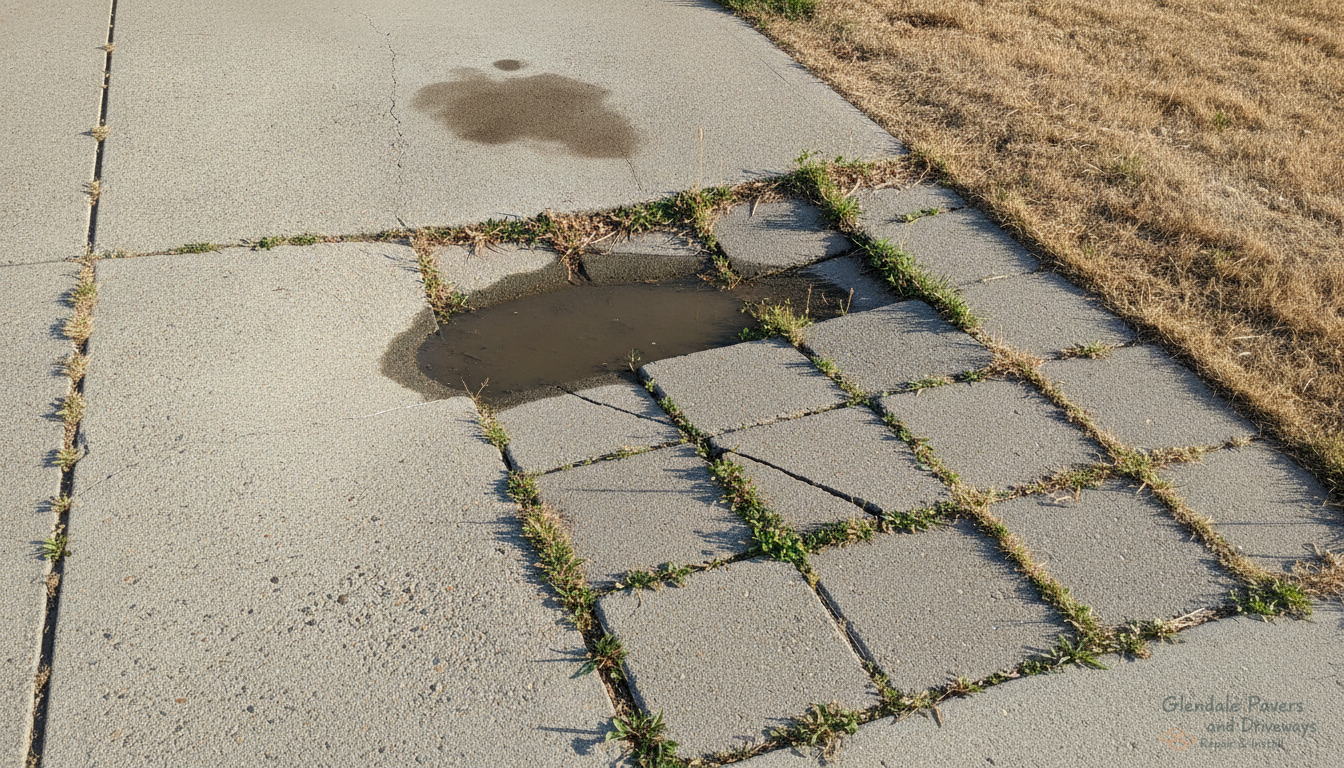
If you notice a low spot in your driveway or patio where water pools after rain, the base material beneath those pavers has likely eroded, compressed unevenly, or been undermined by a nearby tree root. Sunken pavers create trip hazards, damage vehicle tires and suspensions, and allow water to pool against your foundation or garage slab — all problems that worsen with every rainstorm.
The good news is that targeted paver repair and re-leveling can address sunken sections without disturbing the rest of your surface. Our crew carefully lifts the affected pavers, re-grades the base aggregate, and resets everything to a precise level. Because interlocking pavers are individually removable, the repair is nearly invisible when completed with matching materials.
Warning Sign 2: Cracked or Crumbling Individual Pavers
A single cracked paver is not cause for alarm — it happens, especially on driveways that see heavy vehicle traffic. But multiple cracked units in a concentrated area suggest one of three underlying problems: an inadequate base that is flexing under load, a drainage issue causing freeze-thaw cycling stress (rare in Glendale but possible during cold snaps), or pavers that were under-rated for vehicular traffic from the start.
Individual paver replacement is one of the most cost-effective repairs in hardscaping. We carry a wide inventory of common styles and work to source the closest possible color match to your existing surface. If widespread cracking across most of the surface has occurred, our team will evaluate whether a full driveway paver installation makes more financial sense over the long term.
Warning Sign 3: Weed Growth Through the Joints
Weeds growing up between your pavers are a sign that the polymeric joint sand has washed out, degraded, or was never installed in the first place. Without stable, intact joint sand, pavers begin to shift laterally, gaps widen, and the interlocking action that gives paver surfaces their structural strength is compromised. Weeds also push pavers apart as roots expand, accelerating the problem.
The solution is a thorough cleaning and re-application of polymeric sand across the entire surface, followed by sealing to lock the joints and prevent future washout. Our paver sealing and restoration service combines pressure washing, fresh polymeric sand sweep, and premium sealer in one visit. Homeowners throughout Eagle Rock, Atwater Village, and Highland Park schedule this service every two to three years as part of routine maintenance.
Warning Sign 4: Fading and Staining That Won't Clean Off
Glendale's intense UV exposure causes concrete and natural stone pavers to lose their original color over time. Add in oil drips from vehicles, tannin stains from nearby trees, and biological growth like moss or algae, and a once-beautiful driveway can start to look neglected. Surface fading and staining don't affect structural performance, but they do significantly impact curb appeal and property value.
Professional pressure washing removes the majority of surface staining, efflorescence, and biological growth. Once clean and dry, a high-quality penetrating or film-forming sealer restores color depth and provides a barrier against future staining. Our restoration process can make pavers installed 10 or 15 years ago look close to their original condition. Ask about our wet-look versus natural-look sealer options when you schedule a free estimate in Glendale.
Warning Sign 5: Edge Pavers Spreading or Separating
If the pavers along the border of your driveway or patio are drifting outward or separating from the main field, the edge restraints holding the perimeter in place have failed or were improperly installed. Edge restraints are the invisible structural backbone of any paver installation — without them, the entire surface slowly migrates and loses its interlocking grip.
Repairing failed edge restraints involves lifting the border course, installing new heavy-duty plastic or metal restraint spikes along the perimeter, resetting the border pavers, and re-sanding the joints. If caught early, this repair is relatively minor. Left unaddressed, edge separation spreads inward and eventually requires a much more extensive overhaul of the surface. For hillside properties in Glendale's foothill neighborhoods where soil movement is more active, we also recommend evaluating whether a retaining wall could help stabilize the surrounding terrain and reduce lateral pressure on your hardscape.
When Repair Isn't Enough: Full Replacement Thresholds
Our general guideline is straightforward: if less than 25 to 30 percent of your paver surface has structural issues, targeted repair and re-leveling is almost always the smarter financial choice. Once damage, base failure, or shifting affects more than a third of the surface, the labor cost of piecemeal repair approaches the cost of a full reinstallation — and a full replacement gives you a fresh base, updated aesthetics, and a decades-long new lifespan.
We provide honest assessments at every free on-site evaluation. Our goal is to recommend the solution that best fits your budget and long-term needs, whether that is a simple joint re-sanding or a complete new driveway installation. If your patio, walkway, or driveway is showing any of the warning signs above, call us at (818) 423-4815 or email [email protected]. We serve Glendale and surrounding communities seven days a week, 8:00 AM to 6:00 PM.