The Driveway Decision: More Important Than It Looks
Your driveway covers more square footage of your home's exterior than almost any other single surface. It takes the daily abuse of vehicle traffic, Glendale's blazing summer sun, and the occasional heavy rain of a Southern California winter. Choosing the right driveway material affects not just how your home looks today but how much you spend on maintenance over the next 20 to 30 years. At Glendale Pavers and Driveways Repair & Install, we've installed and repaired all three major driveway surfaces across Glendale and surrounding neighborhoods. Here is an honest, side-by-side comparison to help you decide.
Interlocking Paver Driveways
Appearance and Design Flexibility
Interlocking pavers offer the widest range of design possibilities available in any driveway material. You can select from dozens of colors, textures, shapes, and laying patterns — herringbone, running bond, basket weave, fan, and custom combinations with decorative border courses. This design flexibility means a paver driveway can be tailored to complement virtually any Glendale home style, from Spanish Colonial to craftsman bungalow to contemporary stucco.
Durability and Repairability
Properly installed interlocking pavers can last 25 to 50 years. More importantly, because individual units are removable, a cracked or stained paver can be replaced without disturbing the surrounding surface. Utility repairs — water main breaks, irrigation line work — can be done by lifting a section of pavers and re-laying them afterward, leaving no visible scar the way concrete or asphalt repairs do.
This repairability advantage is especially meaningful in Glendale's older neighborhoods, where aging underground utilities mean driveway cuts are more common. Our paver repair and leveling service addresses everything from sunken sections to cracked units, almost always at a fraction of what a concrete driveway repair would cost.
Maintenance Requirements
Pavers do require periodic joint sand replenishment and sealing — typically every two to three years depending on traffic and sun exposure. Our paver sealing and restoration service keeps joints locked, surfaces protected from UV fading, and oil stains from penetrating the material. When maintained, sealed pavers look newer longer than either concrete or asphalt. Homeowners in Los Feliz, Silver Lake, and Burbank who invest in routine sealing consistently get the best long-term value from their paver installations.
Cost
Interlocking paver driveways have a higher upfront cost than poured concrete or asphalt. However, when you account for the longevity, reduced repair costs, and the property value premium that pavers deliver, the long-term cost of ownership is highly competitive. A well-maintained paver driveway also boosts resale value in a way that a cracked or patched concrete slab never will.
Poured Concrete Driveways
Appearance and Customization
Standard poured concrete has a clean, uniform look that suits modern and minimalist home styles. Stamped concrete can mimic the appearance of pavers or stone at a lower material cost, though it does not replicate the structural benefits of true interlocking units. Color options are more limited than pavers, and once poured, the design cannot be changed without full demolition and replacement.
Durability and Repairability
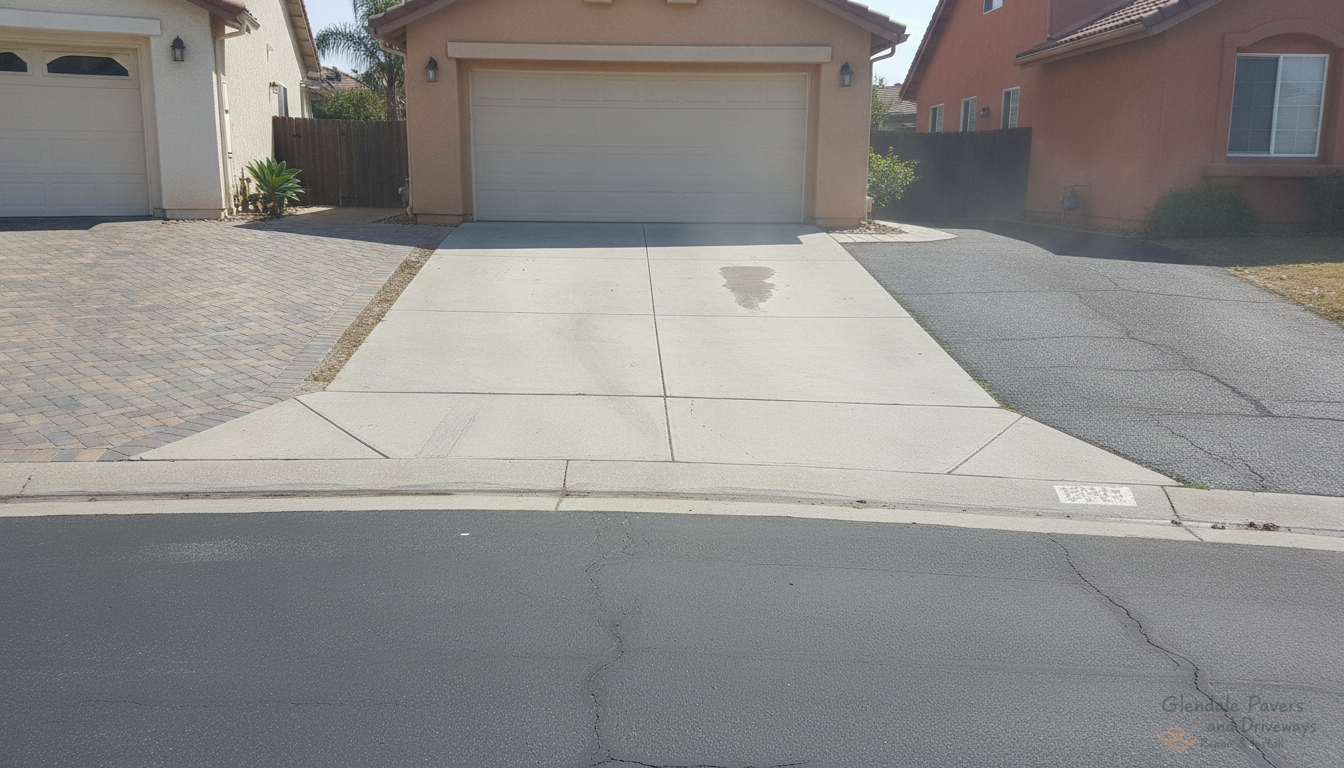
This is where poured concrete driveways have a significant disadvantage in Southern California. Concrete is rigid and does not flex with ground movement — and Glendale's soils, particularly in the foothills, shift and settle more than flat-valley areas. The result is cracking, which is almost inevitable over time. When concrete cracks, repairs are highly visible because the patch color never matches the aged surrounding slab, and structural repairs require saw-cutting and re-pouring entire sections.
Maintenance and Repair Costs
Concrete requires sealing to resist oil staining and UV degradation, similar to pavers. However, crack repairs are considerably more expensive and visually disruptive. Full replacement of a concrete driveway means demolition — breaking out and hauling away the existing slab — which adds significant cost on top of the new pour. Unlike pavers, there is no way to selectively repair only the damaged sections without visible results.
Asphalt Driveways
Cost and Installation Speed
Asphalt has the lowest upfront cost of any driveway material and installs quickly. For homeowners on a tight budget who need a functional surface, it is a practical short-term solution. In cooler climates, asphalt can last 20 or more years with proper maintenance. However, Glendale's summer heat is particularly hard on asphalt.
Performance in Glendale's Climate
Asphalt softens in extreme heat, which means vehicle tires can leave marks, and the surface becomes tacky under heavy sun exposure. In Glendale neighborhoods that regularly hit 95°F to 105°F in summer, this is a genuine performance concern. Dark asphalt also absorbs significantly more heat than lighter-colored concrete or paver surfaces, making the driveway and adjacent outdoor areas uncomfortably hot.
Maintenance Requirements
Asphalt must be seal coated every three to five years to prevent oxidation and surface cracking. Cracks and potholes are filled with cold-patch material that, like concrete repairs, is always visible. Over time, asphalt driveways require regular patching and eventually full milling and repaving — recurring costs that add up over the surface's lifespan.
Side-by-Side Summary
- Design options: Pavers offer the most variety; concrete and asphalt offer very limited customization.
- Repairability: Pavers win outright — individual units are replaced invisibly. Concrete and asphalt repairs are always visible.
- Heat performance: Light-colored pavers and travertine stay cooler than asphalt and comparable to concrete.
- Upfront cost: Asphalt is least expensive; poured concrete is mid-range; pavers are highest upfront but best long-term value.
- Lifespan: Pavers 25–50 years; concrete 15–30 years with repairs; asphalt 15–20 years with maintenance.
- Curb appeal and resale value: Pavers add the most measurable property value premium.
Connecting Your Driveway to the Rest of Your Hardscape
One advantage of choosing pavers for your driveway is how seamlessly the surface can connect to other hardscape features. A paver driveway that flows into a matching front entry walkway and a rear patio creates a cohesive, designed exterior that significantly elevates a home's visual impact. For hillside properties, a new driveway project is also the right time to evaluate whether a retaining wall is needed to stabilize the surrounding slope.
If you are ready to explore a new driveway for your Glendale home, our team at Glendale Pavers and Driveways Repair & Install is available seven days a week to provide a free on-site estimate. Call us at (818) 423-4815, email [email protected], or visit us at 314 E Broadway, Suite C, Glendale, CA 91205. We serve homeowners throughout Glendale and neighboring communities including Eagle Rock, Highland Park, Atwater Village, and Burbank.